The Illusory Nature of Time: I
Condensed from an article by Dr Grahame Blackwell published on The Institute of Noetic Sciences website, Nov. 2009.
“To hold infinity in the palm of your hand, and eternity in an hour”
(William Blake)
—————————————————————————————————–
Summary
Science tells us that the universe kicked off around 13.8 billion years ago, give or take a few million.
So what was going on before then?
We’re told that in the first tiny fraction of a second before the Big Bang, the proto-universe expanded at an exponential rate – doubling in size every instant, from the size of the tiniest sub-atomic particle to millions of light years across. This is the explanation offered for how it’s reached the size and form that it has. [See Inflationary Period.]
But all the evidence suggests that it wasn’t space, but time itself that was going through those dramatic changes in pace in those earliest moments. That fits the facts perfectly.
It also fits another very significant issue that doesn’t seem to have been factored in to the standard explanation. Relativity theory tells us that time slows down near a large mass such as star or a black hole – and the whole universe packed into a space much smaller than a pinhead was certainly a pretty massive and compact mass/energy bundle. Time would have had trouble even getting started in those conditions.
Fortunately there was another factor at play, quite independent of relativity, that eased things up for time to get moving – once the universe had expanded to a sensible size. That leads us down a very interesting rabbit hole, one that may turn out to have no ending … and no beginning.
How far down that particular rabbit hole are you prepared to go?
—————————————————————————————————–

A long backward glance …
Ok, so let’s take a trip backwards down the corridor of time and watch the universe shrink as we head back towards the Big Bang and just beyond, where the cosmos began as an indeterminate state (science-speak for “??*?!!”).
The usual measure of time these days is given by a caesium atomic clock, but that’ll be affected by gravitational forces as the universe reduces in size (see summary above) so we’ll sidestep conventional time measurement and go by the reducing size of the universe instead. We know that was a lot faster, measured against atomic processes, when the universe was very small (the Inflationary Period – backwards), maybe in this way we’ll see why.
[Technical note: The expansion of the universe isn’t time-based in the conventional sense. All other cosmic processes depend on electromagnetic energy flows, but universal expansion, as first discovered by Edwin Hubble in 1929, isn’t driven by those flows. (We know that because it actually stretches electromagnetic waves). That’s why we can use it as an objective measure of the rate of cosmic development – the rate of time.]
[Technical note 2: We’ll be counting distance in light years; one light year is about six trillion miles.]
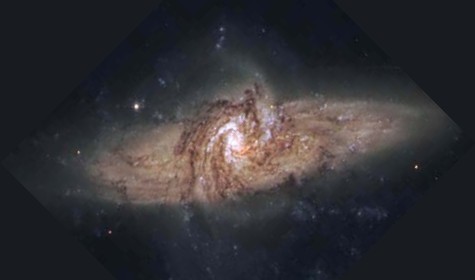
Winding back the light years
Ok, we’re down to a universe 50 billion light years across now, we’ll start watching that caesium clock running backwards as the cosmos shrinks further. 49, 48, 47, 46 … the clock is sticking with us pretty steadily so far. Down to 30, 29, 28, the stars and galaxies are getting a bit closer together now – and is it my imagination or is that clock beginning to run a tad slower?
20, 19, 18 billion light years, stars definitely crowding in now – and yes, that clock is slowing down noticeably. Each billion light years is notching up distinctly less time on the clock, progressively as the universe is shrinking. Not surprising really, the combined gravitational field of all those stars in all those galaxies is getting stronger by the second (if we can still refer to seconds …), slowing that clock down.
Our trip back in time has taken us back over 13 billion years now by our steadily-slowing caesium clock – and the lights are going out all around us. We’re back to the era of formation of the first stars – and back before that, to when the cosmos was relatively dark but seething with the raw energy and scattered elementary particles released by the Big Bang.
Back in time yet further, to when the universe is just millions of light years across – and our clock seems to have virtually hit a brick wall. We’ve reached the Big Bang, followed (i.e. preceded) immediately by the Inflationary Period – the original fraction of a second in the life of the universe.
Just ten million light years now, now eight, and now five … and that clock is positively crawling along, the gravitational time dilation effect is so strong. For every ultra-brief instant that ticks by, the universe shrinks by ten times, a hundred times, a thousand times as much as it did in the last such instant. Looking at it the other way round: for every million light years the universe reduces by, time inches back a hundredth, a thousandth, a millionth of what it did at the previous count. We’re heading towards Cosmic-Time Ground Zero at an ever-decreasing pace, an exponentially decreasing pace – according to our clock.
[For those who missed it, this corresponds to the Inflationary Period in reverse – that Inflationary Period can be explained, at least in part, by the gravitational slowing-down of time. Conventional theory attributes that inflation to an inflaton field, a hypothetical concept postulated specifically to address that issue.]
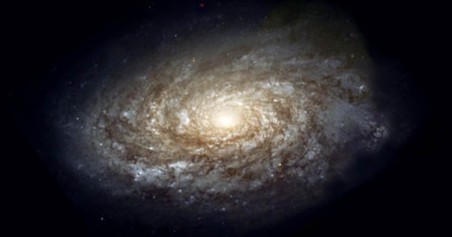
The universe is just a few thousand miles across now, energy equivalent to the mass of trillions of galaxies, sextillions of stars, packed into a volume smaller than the earth. Not surprisingly, with such an absolutely astronomical (!!) gravitational field, our poor clock has pretty well ground to a standstill. We see no change in its reading at all as the universe pops back to that initial state, then back to who-knows-where-or-what before that.
So sure, our universe may have existed for around 13.8 billion years by that caesium clock or a similar device. But that actually tells us nothing about the real age of the cosmos, since that clock would hardly have got moving until the universe was at least several billion miles across. And whilst it was brewing in that point singularity – an infinite gravitational field – the clock wouldn’t have registered anything at all. So how long was that going on for??
This simple analysis offers a clear explanation for the so-called Inflationary Period. It wasn’t the universe expanding incredibly fast, it was time moving incredibly slowly – making it look as if everything was happening at lightning speed (or rather faster than that, in fact).
It also offers us much, much more. For that we need to think briefly about Infinite Geometric Series.
Infinity in a Blank Sheet of Paper
You know all about geometric series. You could make one now – all you need is a sheet of paper and a pair of scissors (or just a good imagination). Take your sheet of paper and cut it in half. Put one half to one side, cut the other piece in half again. Put one half of that with your original half-sheet and cut the other piece in half again. Keep doing that …

You should end up with a pile of bits of paper: ½-sheet, ¼-sheet, 1/8th, 1/16th, etc, etc. In theory you could go on for ever and end up with an infinite number of pieces – but you’d never have more paper than you had in that original sheet.
Just as we piled up a never-ending heap of bits of paper from a total of just one sheet, so we can notch up a never-ending succession of cosmic intervals – each embodying major cosmic development - from 13.8 billion years of clock time. Those intervals show up as smaller, and smaller, and smaller on our clock as it runs ever more slowly backwards towards, but never actually reaches, the beginning of it all.
As another analogy, we could liken our quest to that of the frog on the lily-leaf, endlessly jumping halfway from its current position towards the edge of the leaf – and so never reaching that so-near-and-yet-so-far goal.
That point of origin that we think we can put a figure on might prove elusively forever just beyond our reach if we boarded our hypothetical time machine and confidently headed back towards Time Zero. Not because we’re getting slower, but because each successive ‘nearly there’ clock-tick stretches out to a century, a million years, a billion years-worth and far, far beyond, of cosmic evolution in real terms. There was no Time Zero.

So Question: has the universe been around an infinite length of time or hasn’t it? Answer: You’re asking the wrong question. To treat time as if it’s an objective reality is to totally miss the point.
What this actually shows is that time is a construct of consciousness, a tool to help us steer our way through a realm that would seem truly weird if we could see it as it really is. This blog post is just an intro to that weirdness, time gets even weirder than that – see the next post. Similar sorts of observations can be made about distance. But that’s another story.
See this published article related to this subject.
Photos by NASA and The Hubble Heritage Team (STScI/AURA).