Hornets' Nest
by Grahame Blackwell
©
1980
Published in Practical
Computing, August 1980
For around the
thousandth time since leaving the house, the young man felt for the shiny new
ultra‑intelligent machine (UIM) pendant round his neck. Third generation
– same
technology, they had told him, as the unit now directing operation MOP.
The pendant was a
going‑away present from his parents, and now Mark was heading downtown for a
goodbye drink with some friends. He was early, but he didn't mind, he could use
the time to think things over. Events had moved so fast in the last few months;
it seemed like he'd just left college and tomorrow he was off to join the
project team. Just at the right time, too. The Mars Oxygenation Programme, the
big project of the decade, had been something of a sick joke until recently, but
the latest news was that things were really moving now, thanks to the new
director.
This thought sent
his hand straying towards the pendant again, as he pushed open the barroom door.
Whether he was just making sure it was still there or clutching it as a lucky
talisman, no‑one, not even he, could say ‑ it just felt good to know it
was there.
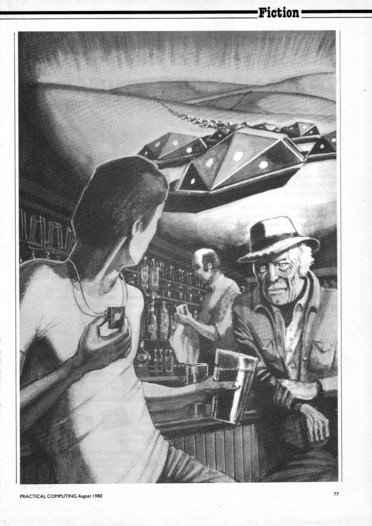 "Mind it don't bite you,
sonny". He looked round sharply, grinned in response to the open, friendly smile
from the old-timer who had spoken. The leathery face assumed a serious look as
the man spoke again: "That's a mighty fine gadget, boy. A mite tidier than the
first of them, way back in '83".
"Mind it don't bite you,
sonny". He looked round sharply, grinned in response to the open, friendly smile
from the old-timer who had spoken. The leathery face assumed a serious look as
the man spoke again: "That's a mighty fine gadget, boy. A mite tidier than the
first of them, way back in '83".
Mark looked with a
new respect into those deep, piercing eyes, eyes which he suddenly realised
must have spent more hours prising secrets from glowing VDU screens and
fathoming the intricacies of hand‑soldered circuit boards than he would care to
guess. Never before had he met one of the now almost legendary Silicon Valley
prospectors.
The so‑called
prospectors had had their heyday in the '70s and '80s, when the rush to
exploit the micro explosion was closely akin to the gold rush of a century or so
before. Pioneers and visionaries, their uncanny talents for making
microprocessors sing and dance or anything else that was useful or profitable
–
preferably both
–
were much in demand. Until, that is, the big business combines stepped in and
everything became much more organised and much less exciting. Yet developments
were still accelerating, and there were stories.
Mark hadn't missed
the cue in the other's last comment. Sensing a story, he returned the response
clearly expected of him: "How do you mean, back in '83? It's well known that the
first of the ultra‑intelligent machines was Randolph's system, just after the
turn of the millenium. It wasn't until '88 that the first system was generally
accepted to have passed the Turing test for a thinking machine, and it was
another 15 years before Paul Randolph coaxed such a system to produce the design
for the first generation UIMs. They produced the second generation just eight
years ago and they were responsible for
–",
and he glanced down at his pendant, embarrassed suddenly by his schoolboyish
enthusiasm.
The oldster smiled.
"You learned your lessons well, boy, but they don't tell you everything at
school. In college they tell you a lot about Babbage and Hollerith, and fill
your head with facts and figures about ACE and ENIAC, but they leave out the
in‑between years
–
the most interesting years, I reckon. They can't make you feel the heat, the
smell, the taste of the atmosphere between those racks of valves; I was just a
kid then, but I'll never forget".
He paused, sipped
his beer. "By the time I left school, we were into the second generation, and
the field was wide open. If you could spot a dud nickel delay line, or code a
neat set of input/output routines, you could write your own ticket.
“Of course, when
IBM produced 360s, then the 370s with their megabyte main-store and nanosecond
cycle times, everyone said it was all up for the seat‑of-the‑pants programmers.
Anyone with a Fortran or Cobol course behind them
–
they taught you about programming languages, didn't they?
–
could do anything they wanted as quick as it was needed, and even flowchart it
in a way that everyone could understand. I got a nice little number with a
communications firm, doing work on CAD and control systems. I was just having
some interesting results from the gadgets I'd hooked up when the micro started
to make a splash, back in the mid‑70s.
“Well, I could see
the way the world was turning and I lashed out on as much of the stuff as I
could. Soon, I'd wired together my own little multiprocessor setup, and I was
adding to it every week. After a while, I looked round and found a few others
who were interested, and we formed a kind of club. We'd meet at my place, some
of them would bring systems they had put together, and we would trade ideas.
"There was a kid,
about your age; no hardware of his own but, boy, there wasn't much he couldn't
make a system do. Used to tap away at my setup for hours, all night sometimes;
didn't seem to have any other interests, nor any friends either, except us I
suppose. I worried about that kid
–
just didn't seem healthy somehow.
“We had been going
about five years, must have been '81, when a new gent joined our club. I say
'gent' because he didn't seem our type at all, always wore a suit and tie and
talked about microelectronics like he'd just learnt it from a textbook. Turned
out later that he had; he was a director for one of the big automobile firms".
At this point the
man paused, as if startled at the revelation, and Mark took the opportunity to
top up the glasses.
"Thanks, son. Well,
as I was saying, it seems the automobile giants were worried. It was just before
the petroleum synthesis process was perfected and it looked like the internal
combustion engine was a dying breed. This gent's firm was diversifying, putting
its capital into other profitable enterprises, and they had recently bought one
of the biggest silicon chip producers in the States. This director was, so to
speak, a talent scout for the firm, and he was impressed by the things we were
doing. So much so, that he offered the kid and me key posts in a hush‑hush
project they were starting.
"Like everyone
else, they were on the artificial intelligence kick, and had this big idea about
machines building cleverer machines. The only difference was, they had the cash
to back their big ideas. They already had a new site in the sticks, on the edge
of the Colorado Desert; production lines set to roll off any design of chip you
cared to ask for ‑ all we had to do was to hook up a system that would design
the new chips and control production.
“Iwas taken on as
systems analyst, and when I heard what the system had to do, I insisted on
taking the kid along to do the programming. They wanted to bring in a team of
programmers, but this had to be a one‑man job if we were going to succeed. The
job specification was concise: rig up a system that would turn out the most
advanced processor possible, using all the CPUs, memory and backing store we
wanted.
"Setting up the
database was a big job, of course; quite a lot of the scientific data we wanted
still wasn't on chip at the time, and we had to set up a text‑reader to input
nearly a library‑full of science texts and formulae into the data banks. I
figured any system aiming to design new circuits would have to be strong on
electromagnetic field theory, so we piled in everything we could find on that.
Seems unfair how you can get into such a heap of trouble just by being right.
"The other
smart‑Alec was one of the company directors. Reckon he was a sci‑fi fan ‑ had
some scary ideas about machine intelligence and insisted we built Asimov's first
law of robotics into the system. You know the deal"?
The younger man
nodded and intoned, almost reverentially: "No robot can harm a human being, or,
through inaction, allow a human being to come to harm". Mark, too, was a sci‑fi
fan, and to him Asimov was the Old Master.
"Yeah, that's it”.
The other sounded less enchanted, for some reason. "Well, that gave the kid some
problems in his programming, I can tell you. It also meant we had to add a whole
stack of human psychology and sociology journals to the data input, so the
system would know about human behaviour. Mind you, that was nothing to the
problems it landed us in later
–
friend Asimov has plenty to answer for.
"Well, I rigged up
the sweetest little 12‑processor system you ever did see, though I do say so
myself. About five gigabytes of backing store, and direct control of the
processing plant. As an afterthought, I linked in another CPU, out of phase with
the others, to cut in between cycles and check they were all OK; any CPU that
went down would be switched out of the system automatically. Some say that was
the unlucky move, adding the 13th processor, but I ain't superstitious.
"I didn't see
anything of the kid for months. Sometimes when I looked in on him he'd be
working through a mile or two of program listing, else he'd be tapping away at
his terminal, or putting a subroutine through its paces. He had his meals
brought in to him, and even slept on a camp bed he had brought in. Didn't
seem bothered about social niceties, either ‑ you know, washing, shaving,
changing his clothes
– details like that. Visitors always left quickly ‑ I think
that suited him. Like I said before, there was something about that kid that
wasn't healthy, and I don't just mean the smell.
“You know, the more
I tell this story, the more I wonder. How could I have not seen it coming?
Perhaps I was just too busy
– perhaps I was just too dumb.
"Anyway, one day
the kid wandered casually into my office, mentioned that the system was up and
running, left and crashed out on his camp bed for 24 hours. It took me a few
minutes to realise what he meant. I rushed out to the production lines to see.
Nothing, of course. The system was chewing over all the facts and figures and
formulae we had given it, and it was going to be some hours at least before it
started spewing out the bright new future we were hoping for, in the shape of
some super‑powerful chip.
"Two days later,
still nothing happening, I was getting worried. The kid, who by this time had
even washed and shaved, tapped away at his monitor and told me confidently it
was all OK. Apparently the system was referencing data on optimisation
techniques; he figured it must have worked out the circuit it wanted and was
deciding on the best way of laying it. I was whacked
– I'd been up for the last
48 hours
– so I left him watching the show and went for some sleep”.
The old‑timer
paused, stared reflectively into his glass for a few moments. Then he spoke
again, more to himself than to Mark, as if the other's presence no longer
mattered.
"I don't know how
long I slept, but I woke up with one of the technicians shaking the living
daylights out of me. He didn't say a word, just stepped across and pulled open
the curtains, then waited for me to come and look.
"My first
impression was that we were being invaded. A column of insects, soldier ants or
locusts maybe, was heading into the complex from out in the desert, as far as
the eye could see. Then I realised my mistake
–
the column
was moving, slowly but steadily, away from the complex. Something was heading
out of our production plant at the rate of thousands an hour, and had been for
quite a few hours, by the looks of it.
"In the 10 seconds
it took me to dress and get down there, the technician told me that the plant
had started in the middle of the night. The products were unusual, but they'd
decided to turn in and leave it until I woke to study them ‑ nothing odd was
gong on then.
“Down on the sand,
I watched them creeping out under one of the cargo doors. Not ants or locusts,
more like beetles, Colorado beetles perhaps; brownish, with gold spots all over.
I picked one up; it was shaped like a beetle, too ‑ kind of oval, but with flat
surfaces all round it and at the ends. The gold spots were on the flats, some
sort of contacts, I suppose. I put it down, and it moved off again, same
direction, same speed as all the others. We figured later that they all
had a kind of linear motor built in, and were dragging themselves along the
earth's magnetic field lines. You know, like the monorail systems, a kind of
magnetic induction process. Very efficient, and no moving parts.
"Well, of course,
we shut the plant down. Any fool could see that the system had gone a bit
neurotic
– leastways, that's what this particular fool figured. The kid settled
back to his monitor to try and debug the system, while I took a team out to
debug the desert
– literally.
'Two technicians
had been out in a jeep to see where our bugs were heading, and they came back
with a report that they were all piling up at a spot about three miles out, like
some massive seething antheap. All we had to do was to get out there, wait till
they all arrived, then shovel them into the back of a truck. On impulse, I took
a few instruments out with us. I had a theory.
"I don't know how
many there were in that pile, must've been thirty or forty thousand, and more
arriving by the minute. I set up my instruments as close to the pile as
possible, and quickly confirmed my guess: this spot in the desert was a node in
the earth's magnetic field, a kind of magnetic powerhouse. I was just
congratulating myself on figuring this irrelevant detail when, all of a sudden,
the lights went out. In the middle of the desert, mid‑morning, it just went
black. I stumbled around, tripped over my instruments, then hit a rock about
four foot high. But there were no rocks here. I backed off; that heap of bugs
had suddenly set rock‑solid.
“I heard people
calling me, and ran towards the voices. Suddenly I was in blazing sunlight
again, with the others just a few feet away. I looked back the way I had just
come and saw nothing. Nothing but sand, and sky, and the stream of bugs from the
plant, now disappearing as soon as they hit a certain point on the sand. The
technicians told me I had suddenly disappeared, along with the heap of bugs,
then just as suddenly stepped out from nowhere in front of them. I told them
about the dark, and waved my arm back the way I'd just come
–
my arm disappeared. I pulled it back, stepped carefully in that direction. The
technicians gasped
–
seems I had disappeared again
–
and I was back in the black.
"Electrornagnetic
wave distortion, the old sci‑fi invisibility field. So simple, just bend the
light rays round whatever you want to hide and you see past it, or through it,
as if it were not even there. Our heap of bugs was the first brain to overcome
the technical problems and make it happen.
"We wasted about 10
minutes pacing out the size of the distortion field
–
walking in what looked like straight lines, but weren't
–
before it occurred to me to wonder just why our brainchild wanted to hide
itself. We laid out some markers for the bombers
–
I was beginning to think at last
–
then piled into the truck. It only took us 10 seconds to confirm that the
truck's electrics were dead, and figure where the blame lay. As we ran back to
the complex I mentally crossed off aircraft and guided weapons from my list of
possibilities, and cursed myself for a fool for giving the monster such a
thorough education.
“I was the last
back, and I found the technicians with a group of workers, watching weird
patterns drifting across one of the system's monitors which were dotted round
the place. I turned away, and yelled at them to do the same, but I was too late.
I went looking for the kid, and found him tapping away at his console while
those patterns flickered across his VDU. He was keying in the parameters to
re‑start the system. That heap sure had everything under control
–
everything except me. I pulled off my shoe and knocked him cold, then I pulled
the plug on that screen. While he came round, I disconnected all the other VDUs,
though it didn't seem to do much for the zombies standing round them.
“The kid seemed
none the worse for wear, apart from a lump on the head. I cut short his
questions about the system, and asked for some straight answers to some very
personal questions. I asked him about his childhood, his family, his friends,
regular headshrinker stuff. He squirmed, it wasn't easy for him, but there were
things I had to know.
“At last I had it.
The kid had a standard set of hang‑ups, was no more or less neurotic than your
average introvert, but he majored on the theme of mankind being man's worst
enemy, man needing protection from himself. That idea was bound to carry over,
subconsciously, into a program as complex as ours. Any superbrain with Asimov's
first law built in had to disable man's worst enemy
–
harmlessly, of course.
"Our heap of bugs
wasn't nuts. It was terrifyingly sane.
"There wasn't much
time, it was sure to try and regain control somehow. There was no way of
knowing how far afield it was interfering with TV broadcasts, taking over
unsuspecting viewers, or what other tricks it had up its junctions. I told the
kid the data modifications I wanted, and he keyed them in from his terminal,
blind, with the screen covered over. Then he started the program again, from a
restart point shortly before the production routine, so it would refer to the
new data before it set up the next production run. We sat back and waited.
"Four hours later
the exodus began again, little electronic Colorado beetles creeping out to their
rendezvous with nothingness. After another four hours I started switching in one
of the system monitors every 10 minutes, just for a few seconds. On the ninth
try, the screen was clear. We drove out to the abandoned truck with a spare
battery, and it started, no trouble. There was still no sign of the heap, and
those new bugs were disappearing at steady rate".
Up to this point,
Mark had listened, fascinated, but now he felt he must query what seemed to be
an inconsistency. "Surely, if you had corrupted the database, the new chips
would be faulty", he objected. "Wouldn't your bugheap, as you call it, simply
have rejected them"?
The older man
nodded. "That's true, son, it would, if my modifications had been out of line
with the original data but it wasn't.
"You see, boy, I
wasn't the first one with bug problems. Middle of the last century, scientists
controlled some types of insect pests effectively by sneaking large numbers of
strong males, radiation sterilised, into a swarm. These fellas came on strong
with the lady bugs, making sure a whole load of the eggs never hatched. Wasn't
long before the swarm dwindled and died away.
"My new chips were
the sterile males for the bugheap. They were accepted because their data was
consistent with the original chips".
“'But what mod did
you make, to have that effect"? asked Mark. "Surely not just the old
tie‑the‑computer‑up‑with‑a‑paradox routine"?
"Well, I suppose it
was a kind of paradox, but I didn't see it like that. Not the type you mean
–
"the statement I am now making is not true" or some such. I've never yet met a
computer that became knotted‑up in words the way we seem to. No, I simply added
to its logic design data the fact that the original system had been designed,
programmed and provided with data by humans. As I saw it, our only hope was if
the new bugs carried that fact, in some shape or form, out to the heap".
Mark looked puzzled
for about a minute, then smiled. "Clever, but how did you know it would work"?
"I didn't, but when
it let go the monitors, I knew we had got through to it. The way I figure, it
withdrew while it considered this fact that it was a product of man's worst
enemy, so it might actually be a weapon without realising it, aimed at those it
was trying to protect. Far as I know, it's still considering".
Mark gasped: "You
mean it's still out there"?
"Well, I ain't
moved it, son. You'll never find it, though, unless you walk straight into it.
Don't look so worried, it's not done anything for a good few years, don't reckon
it's fixing to start now.
"The workers came
round in 48 hours. So did all the others ‑ local news said nearly every
man, woman and child in an 80‑mile zone had suffered a mysterious blackout. We
never let on why
–
serves them right for watching so much TV.
"The auto bosses
dismantled the plant, of course. Blamed us for wasting millions of their
capital, and gave us the sack. They never discovered exactly what happened
–
the workers couldn't remember a thing, and we weren't set to tell them;
they had enough to worry about keeping their investors happy.
"Well, boy,
wouldn't you agree that our heap qualifies as the first of them
ultra‑intelligent machines? No, don't feel obliged to answer, I can see you have
your doubts about my story. Reckon you'll be convinced soon, though, when your
new director up on Mars starts thinking about those tracks up there they keep
calling canals. I don't reckon that new machine will take long to figure it out.
I just wish I'd been up there to help them when their systems cut loose, that's
all. Well, 'bye son, good luck. Thanks for the drinks".
Mark had glanced
down in embarrassment a moment before, but now his thoughts were in a turmoil.
How did this man know where he was heading? Was he implying what he seemed to be
implying? Mark looked up, his mind full of questions, but only the swinging
barroom door marked the man's exit. From the door, there was no sign of him, up
or down the street.
Mark raced to the
bar. "Who was that man? Where does he live? What does he do"?
The bartender
shrugged. "Old Jed? Oh, he's just some hillbilly lives out in the woods. Comes
into town regular to pick up packages from the post office
–
electrical bits and such like, mostly. Some say he's got a still out in the
woods, fixing moonshine. Few times folks been out looking for his place. Always
come back saying they found themselves going back the way they came. Reckon they
must have stopped off and sampled his produce".
The bartender
grinned at his own joke, and turned back to wiping glasses.

PRACTICAL COMPUTING August
1980